How to Do Power Stairs
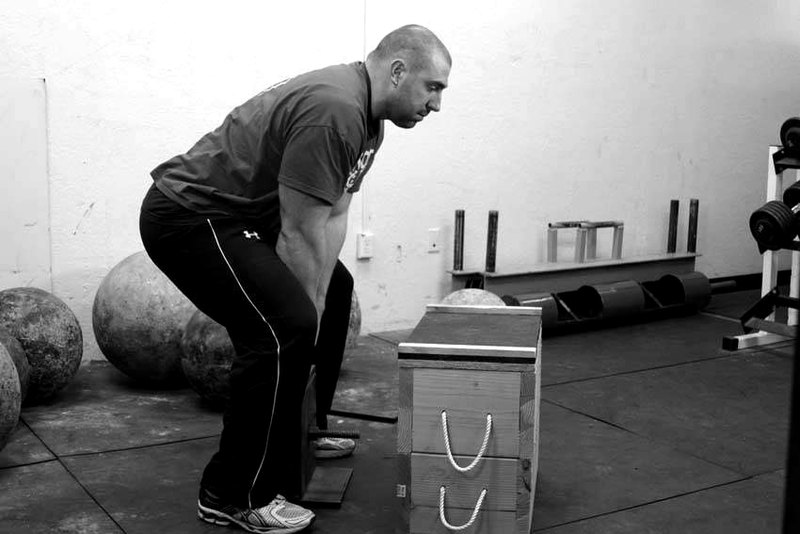
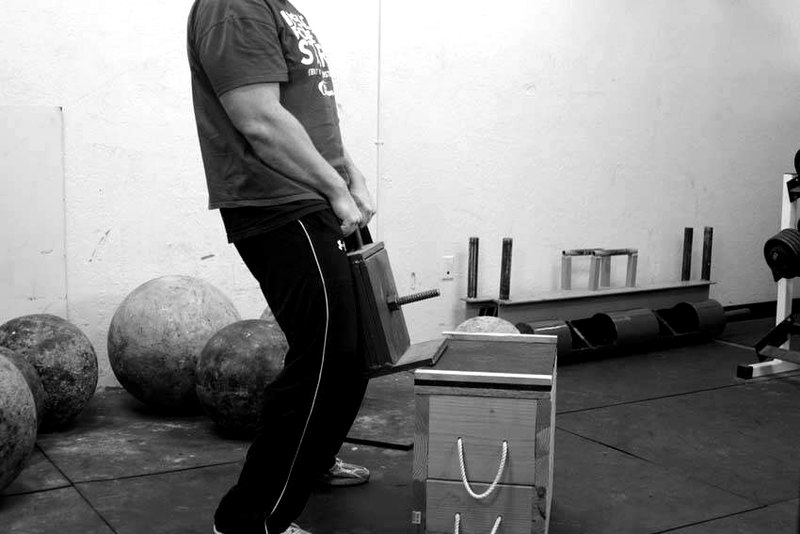
Start and end of one clean rep of Power Stairs.
Quick facts
| Primary muscle | Hamstrings |
|---|---|
| Secondary muscles | Quads, Calves, Glutes, Core, Shoulders, Back |
| Equipment | Machine |
| Category | Strongman |
How to perform Power Stairs
- In the power stairs, implements are moved up a staircase. For training purposes, these can be performed with a tire or box.
- Begin by taking the implement with both hands. Set your feet wide, with your head and chest up. Drive through the ground with your heels, extending your knees and hips to raise the weight from the ground.
- As you lean back, attempt to swing the weight onto the stairs, which are usually around 16-18" high. You can use your legs to help push the weight onto the stair.
- Repeat for 3-5 repetitions, and continue with a heavier weight, moving as fast as possible.
Muscles worked
- Hamstrings (primary): bends the knee and extends the hip through hinges and pulls.
- Quads (secondary): extends the knee to drive squats, lunges and jumps.
- Calves (secondary): points the foot to power push-off and steady the ankle.
- Glutes (secondary): extends and stabilises the hip — the engine behind hinges, squats and sprints.
- Core (secondary): braces the trunk and resists twisting to protect the spine.
- Shoulders (secondary): raises and rotates the arms and drives everything overhead.
- Back (secondary): pulls the arms down and toward the torso and keeps the spine stable.
Sets & reps by goal
| Goal | Sets × reps | Load | Rest |
|---|---|---|---|
| Strength | 3–5 × 3–5 | Heavy (~85%+) | 2–3 min |
| Hypertrophy | 3–4 × 8–12 | Moderate (~65–75%) | 60–90 s |
| Endurance | 2–3 × 15–20 | Lighter (~50–60%) | 30–45 s |
Pick the row that matches your goal. If you're newer, anchor in the hypertrophy range while you groove the form.
Form tips
- Lead with the hips, keep a soft knee and hold a long, flat back through the hinge.
- Set the seat and pads so the machine's pivot lines up with the joint you're training before your first rep.
- Brace hard and keep a neutral spine; loaded odd-object work punishes a loose torso fast.
- Stop a rep or two short of failure on most sets to keep form clean and recover faster.
Common mistakes
- Rounding the lower back to reach lower instead of hinging at the hips.
- Leaving the seat or range on a setting that forces the joint into an awkward angle.
- Letting the torso round the moment the object leaves the floor.
Frequently asked questions
What muscles does Power Stairs work?
Power Stairs mainly works the hamstrings, with the quads, calves, glutes, core, shoulders, back helping as secondary movers.
What equipment do I need for Power Stairs?
Power Stairs needs the corresponding weight-stack or plate-loaded machine.
How many sets and reps should I do for Power Stairs?
It depends on your goal: about 3–5 sets of 3–5 heavy reps for strength, 3–4 sets of 8–12 for muscle growth, or 2–3 sets of 15–20 for endurance. Pick the row that matches your goal. If you're newer, anchor in the hypertrophy range while you groove the form.
Train Power Stairs with a coach in your pocket
Gimmy is your AI gym buddy — it programs Power Stairs into recovery-aware workouts, tracks your sets, and shows one score that tells you if it's working.
Get early access