How to Do Otis-Up
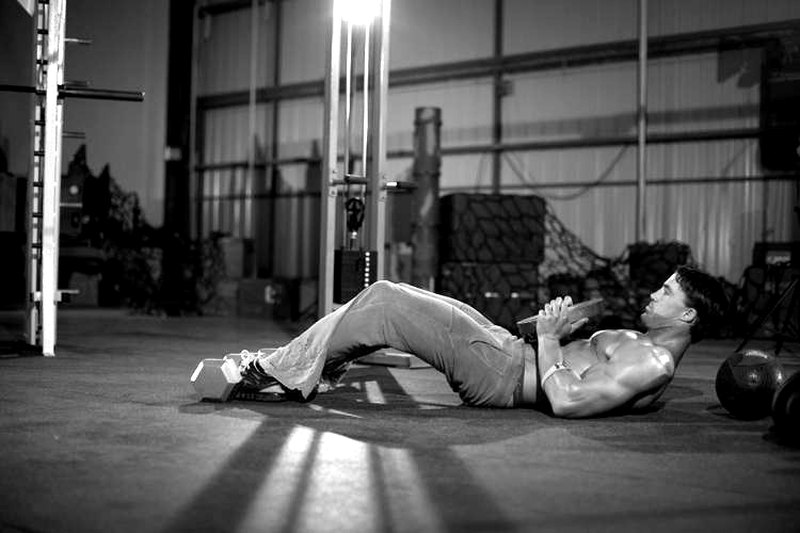

Start and end of one clean rep of Otis-Up.
Quick facts
| Primary muscle | Core |
|---|---|
| Secondary muscles | Chest, Shoulders, Triceps |
| Equipment | Machine |
| Category | Strength |
How to perform Otis-Up
- Secure your feet and lay back on the floor. Your knees should be bent. Hold a weight with both hands to your chest. This will be your starting position.
- Initiate the movement by flexing the hips and spine to raise your torso up from the ground.
- As you move up, press the weight up so that it is above your head at the top of the movement.
- Return the weight to your chest as you reverse the sit-up motion, ensuring not to go all the way down to the floor.
Muscles worked
- Core (primary): braces the trunk and resists twisting to protect the spine.
- Chest (secondary): pushes the arms forward and across the body — your horizontal pressing power.
- Shoulders (secondary): raises and rotates the arms and drives everything overhead.
- Triceps (secondary): straightens the elbow to lock out every press and pushdown.
Sets & reps by goal
| Goal | Sets × reps | Load | Rest |
|---|---|---|---|
| Strength | 3–5 × 3–5 | Heavy (~85%+) | 2–3 min |
| Hypertrophy | 3–4 × 8–12 | Moderate (~65–75%) | 60–90 s |
| Endurance | 2–3 × 15–20 | Lighter (~50–60%) | 30–45 s |
Pick the row that matches your goal. If you're newer, anchor in the hypertrophy range while you groove the form.
Form tips
- Brace as if about to take a light punch and breathe shallowly — don't hold your breath for the whole set.
- Set the seat and pads so the machine's pivot lines up with the joint you're training before your first rep.
- Treat every rep the same — a repeatable setup and bar path is what lets you add weight safely over time.
- Control the lowering phase — a 2–3 second descent builds more than dropping the weight.
Common mistakes
- Cranking with the hip flexors or neck instead of moving from the trunk.
- Leaving the seat or range on a setting that forces the joint into an awkward angle.
- Chasing weight jumps before the current load feels solid on every rep.
Frequently asked questions
What muscles does Otis-Up work?
Otis-Up mainly works the core, with the chest, shoulders, triceps helping as secondary movers.
What equipment do I need for Otis-Up?
Otis-Up needs the corresponding weight-stack or plate-loaded machine.
How many sets and reps should I do for Otis-Up?
It depends on your goal: about 3–5 sets of 3–5 heavy reps for strength, 3–4 sets of 8–12 for muscle growth, or 2–3 sets of 15–20 for endurance. Pick the row that matches your goal. If you're newer, anchor in the hypertrophy range while you groove the form.
Train Otis-Up with a coach in your pocket
Gimmy is your AI gym buddy — it programs Otis-Up into recovery-aware workouts, tracks your sets, and shows one score that tells you if it's working.
Get early access