How to Do Squat Jerk
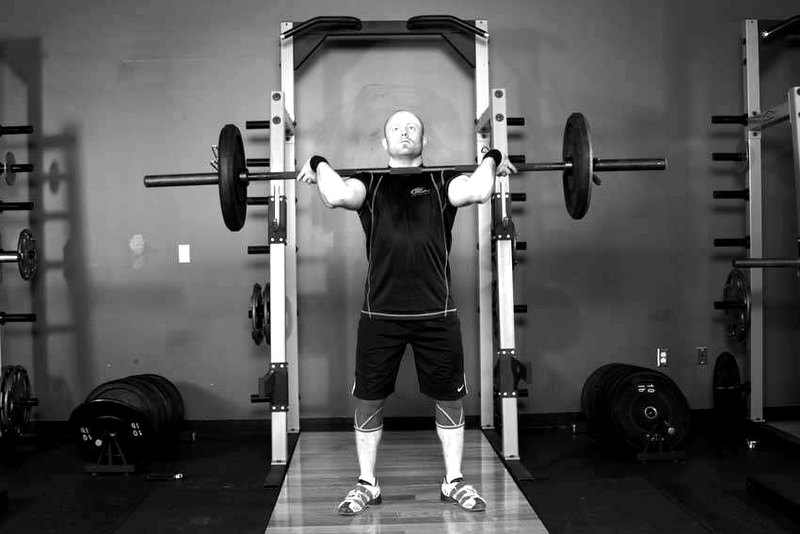
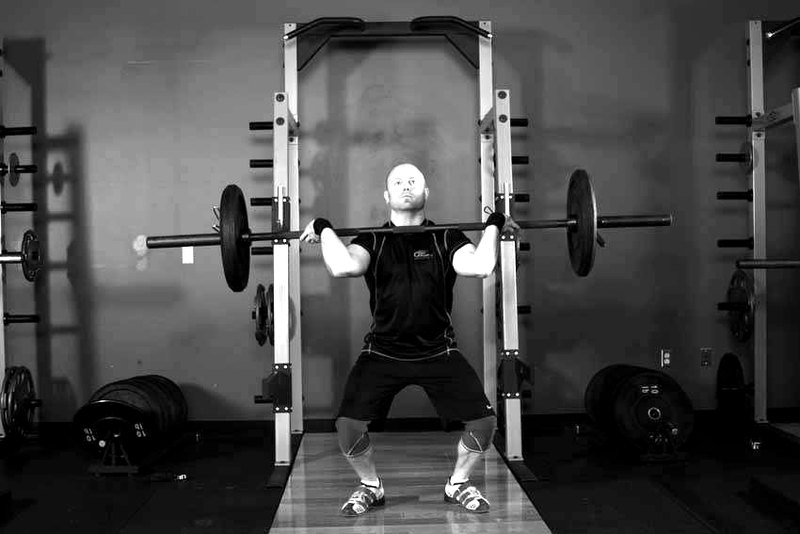
Start and end of one clean rep of Squat Jerk.
Quick facts
| Primary muscle | Quads |
|---|---|
| Secondary muscles | Calves, Glutes, Hamstrings, Shoulders, Triceps |
| Equipment | Barbell |
| Category | Strength |
How to perform Squat Jerk
- Standing with the weight racked on the front of the shoulders, begin with the dip. With your feet directly under your hips, flex the knees without moving the hips backward. Go down only slightly, and reverse direction as powerfully as possible. Drive through the heels create as much speed and force as possible, and be sure to move your head out of the way as the bar leaves the shoulders.
- At this moment as the feet leave the floor, the feet must be placed into the receiving position as quickly as possible. In the brief moment the feet are not actively driving against the platform, the athlete's effort to push the bar up will drive them down. The feet should move forcefully to just outside the hips, turned out as necessary. Receive the bar with your body in a full squat and the arms fully extended overhead.
- Keeping the bar aligned over the front of the heels, your head and chest up, drive throught heels of the feet to move to a standing position. Carefully return the weight to floor.
Muscles worked
- Quads (primary): extends the knee to drive squats, lunges and jumps.
- Calves (secondary): points the foot to power push-off and steady the ankle.
- Glutes (secondary): extends and stabilises the hip — the engine behind hinges, squats and sprints.
- Hamstrings (secondary): bends the knee and extends the hip through hinges and pulls.
- Shoulders (secondary): raises and rotates the arms and drives everything overhead.
- Triceps (secondary): straightens the elbow to lock out every press and pushdown.
Sets & reps by goal
| Goal | Sets × reps | Load | Rest |
|---|---|---|---|
| Strength | 3–5 × 3–5 | Heavy (~85%+) | 2–3 min |
| Hypertrophy | 3–4 × 8–12 | Moderate (~65–75%) | 60–90 s |
| Endurance | 2–3 × 15–20 | Lighter (~50–60%) | 30–45 s |
Pick the row that matches your goal. If you're newer, anchor in the hypertrophy range while you groove the form.
Form tips
- Keep the knees tracking in line with the toes and push the whole foot into the floor.
- Keep the bar path close and stacked over your mid-foot; letting it drift forward wastes force and loads the lower back.
- Treat every rep the same — a repeatable setup and bar path is what lets you add weight safely over time.
- Warm up the pattern with a couple of lighter, submaximal sets before your working sets.
Common mistakes
- Letting the knees cave inward as you push out of the bottom.
- Loading the bar heavier than your form allows and turning strict reps into a whole-body heave.
- Chasing weight jumps before the current load feels solid on every rep.
Frequently asked questions
What muscles does Squat Jerk work?
Squat Jerk mainly works the quads, with the calves, glutes, hamstrings, shoulders, triceps helping as secondary movers.
What equipment do I need for Squat Jerk?
Squat Jerk needs a barbell and plates (plus a rack or bench where the movement calls for one).
How many sets and reps should I do for Squat Jerk?
It depends on your goal: about 3–5 sets of 3–5 heavy reps for strength, 3–4 sets of 8–12 for muscle growth, or 2–3 sets of 15–20 for endurance. Pick the row that matches your goal. If you're newer, anchor in the hypertrophy range while you groove the form.
Train Squat Jerk with a coach in your pocket
Gimmy is your AI gym buddy — it programs Squat Jerk into recovery-aware workouts, tracks your sets, and shows one score that tells you if it's working.
Get early access