How to Do Linear 3-Part Start Technique
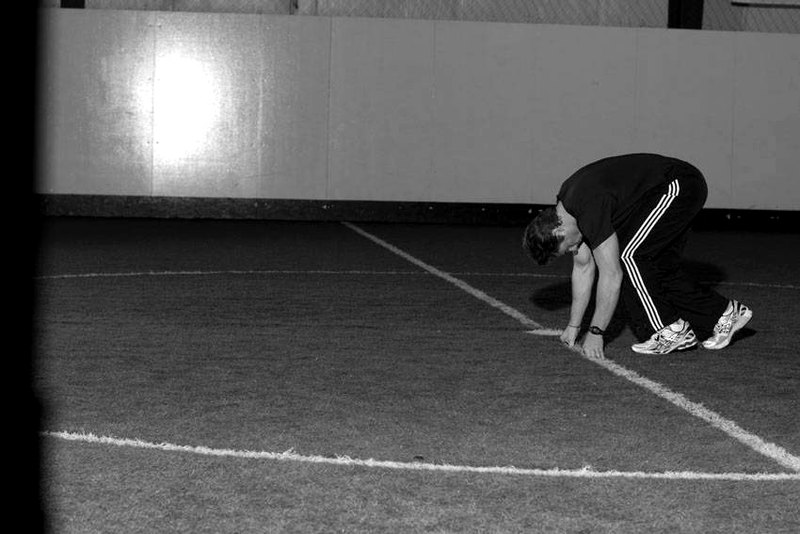
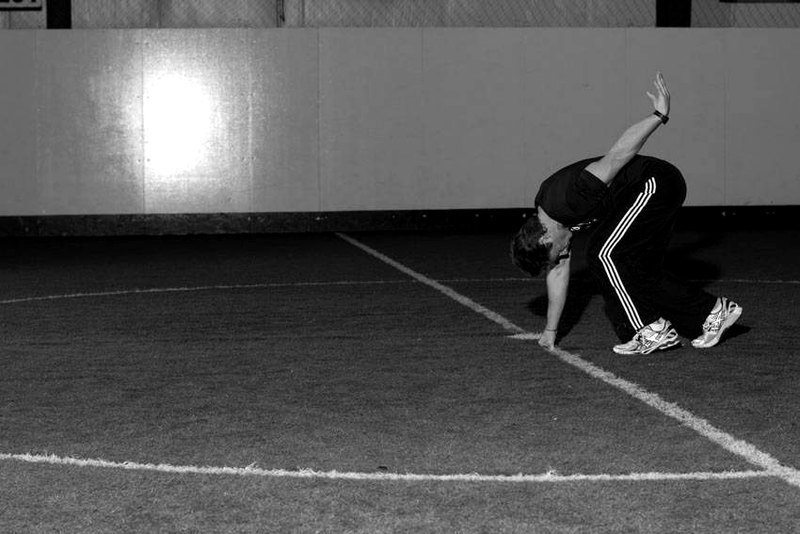
Start and end of one clean rep of Linear 3-Part Start Technique.
Quick facts
| Primary muscle | Hamstrings |
|---|---|
| Secondary muscles | Calves, Quads |
| Equipment | Bodyweight |
| Category | Plyometrics |
How to perform Linear 3-Part Start Technique
- This drill helps you accelerate as quickly as possible into a sprint from a dead stop. It helps to use a line to start from. Begin with two feet on the line. Place your left foot with the toe next to your right ankle. Place your right foot 4-6 inches behind the left.
- Place your right hand onto the line, and thing bring your nose close to your left knee.
- Squat down as you lean foward, your head being lower than your hips and your weight loaded onto the left leg. This will be your starting position.
- Take your left hand up so that it is parallel to the ground, pointing behind you, and explode out when ready.
Muscles worked
- Hamstrings (primary): bends the knee and extends the hip through hinges and pulls.
- Calves (secondary): points the foot to power push-off and steady the ankle.
- Quads (secondary): extends the knee to drive squats, lunges and jumps.
Sets & reps by goal
| Goal | Sets × reps | Load | Rest |
|---|---|---|---|
| Strength | 3–5 × 3–5 | Heavy (~85%+) | 2–3 min |
| Hypertrophy | 3–4 × 8–12 | Moderate (~65–75%) | 60–90 s |
| Endurance | 2–3 × 15–20 | Lighter (~50–60%) | 30–45 s |
Bodyweight movement: once you own the top of a rep range, progress by slowing the tempo, pausing at the hardest point, or moving to a harder variation instead of adding load.
Form tips
- Lead with the hips, keep a soft knee and hold a long, flat back through the hinge.
- Own the largest range you can control with clean form before you chase extra reps.
- Land softly through the whole foot with bent knees to absorb the force, and reset fully between reps.
- Stop a rep or two short of failure on most sets to keep form clean and recover faster.
Common mistakes
- Rounding the lower back to reach lower instead of hinging at the hips.
- Cutting the range short to squeeze out extra reps instead of owning each full one.
- Landing stiff-legged or with locked knees, which spikes the load on the joints.
Frequently asked questions
What muscles does Linear 3-Part Start Technique work?
Linear 3-Part Start Technique mainly works the hamstrings, with the calves, quads helping as secondary movers.
What equipment do I need for Linear 3-Part Start Technique?
None — Linear 3-Part Start Technique is a bodyweight movement, so you only need your bodyweight and a little space.
How many sets and reps should I do for Linear 3-Part Start Technique?
It depends on your goal: about 3–5 sets of 3–5 heavy reps for strength, 3–4 sets of 8–12 for muscle growth, or 2–3 sets of 15–20 for endurance. Bodyweight movement: once you own the top of a rep range, progress by slowing the tempo, pausing at the hardest point, or moving to a harder variation instead of adding load.
Train Linear 3-Part Start Technique with a coach in your pocket
Gimmy is your AI gym buddy — it programs Linear 3-Part Start Technique into recovery-aware workouts, tracks your sets, and shows one score that tells you if it's working.
Get early access