How to Do Decline Reverse Crunch
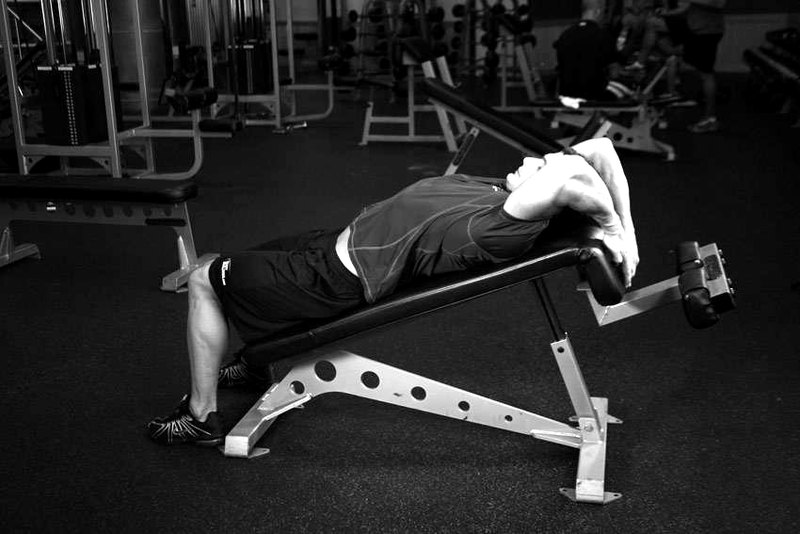
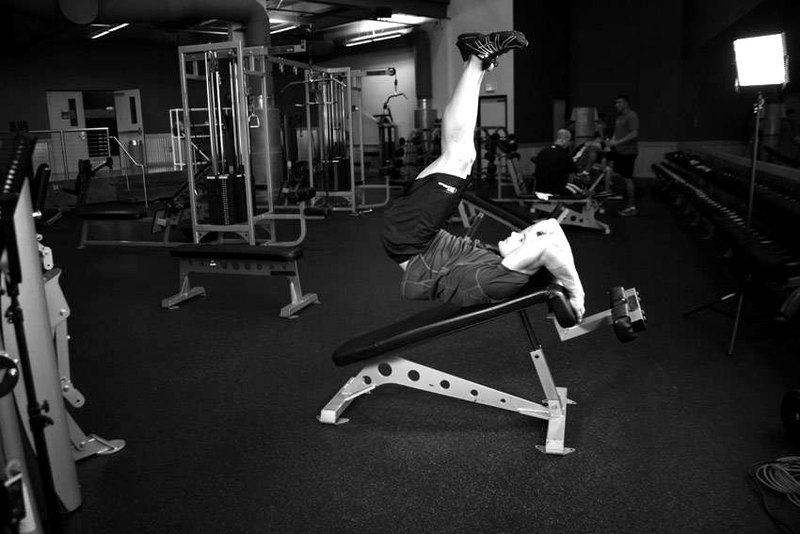
Start and end of one clean rep of Decline Reverse Crunch.
Quick facts
| Primary muscle | Core |
|---|---|
| Secondary muscles | — |
| Equipment | Bodyweight |
| Category | Strength |
How to perform Decline Reverse Crunch
- Lie on your back on a decline bench and hold on to the top of the bench with both hands. Don't let your body slip down from this position.
- Hold your legs parallel to the floor using your abs to hold them there while keeping your knees and feet together. Tip: Your legs should be fully extended with a slight bend on the knee. This will be your starting position.
- While exhaling, move your legs towards the torso as you roll your pelvis backwards and you raise your hips off the bench. At the end of this movement your knees will be touching your chest.
- Hold the contraction for a second and move your legs back to the starting position while inhaling.
- Repeat for the recommended amount of repetitions.
Muscles worked
- Core (primary): braces the trunk and resists twisting to protect the spine.
Sets & reps by goal
| Goal | Sets × reps | Load | Rest |
|---|---|---|---|
| Strength | 3–5 × 3–5 | Heavy (~85%+) | 2–3 min |
| Hypertrophy | 3–4 × 8–12 | Moderate (~65–75%) | 60–90 s |
| Endurance | 2–3 × 15–20 | Lighter (~50–60%) | 30–45 s |
Bodyweight movement: once you own the top of a rep range, progress by slowing the tempo, pausing at the hardest point, or moving to a harder variation instead of adding load.
Form tips
- Brace as if about to take a light punch and breathe shallowly — don't hold your breath for the whole set.
- Own the largest range you can control with clean form before you chase extra reps.
- Treat every rep the same — a repeatable setup and bar path is what lets you add weight safely over time.
- Control the lowering phase — a 2–3 second descent builds more than dropping the weight.
Common mistakes
- Cranking with the hip flexors or neck instead of moving from the trunk.
- Cutting the range short to squeeze out extra reps instead of owning each full one.
- Chasing weight jumps before the current load feels solid on every rep.
Frequently asked questions
What muscles does Decline Reverse Crunch work?
Decline Reverse Crunch is a focused movement that primarily works the core.
What equipment do I need for Decline Reverse Crunch?
None — Decline Reverse Crunch is a bodyweight movement, so you only need your bodyweight and a little space.
How many sets and reps should I do for Decline Reverse Crunch?
It depends on your goal: about 3–5 sets of 3–5 heavy reps for strength, 3–4 sets of 8–12 for muscle growth, or 2–3 sets of 15–20 for endurance. Bodyweight movement: once you own the top of a rep range, progress by slowing the tempo, pausing at the hardest point, or moving to a harder variation instead of adding load.
Train Decline Reverse Crunch with a coach in your pocket
Gimmy is your AI gym buddy — it programs Decline Reverse Crunch into recovery-aware workouts, tracks your sets, and shows one score that tells you if it's working.
Get early access