How to Do Reverse Flyes With External Rotation
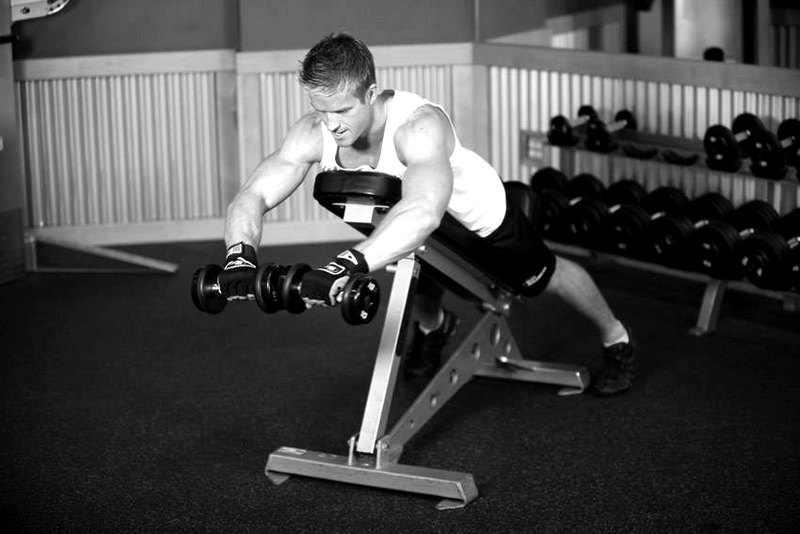
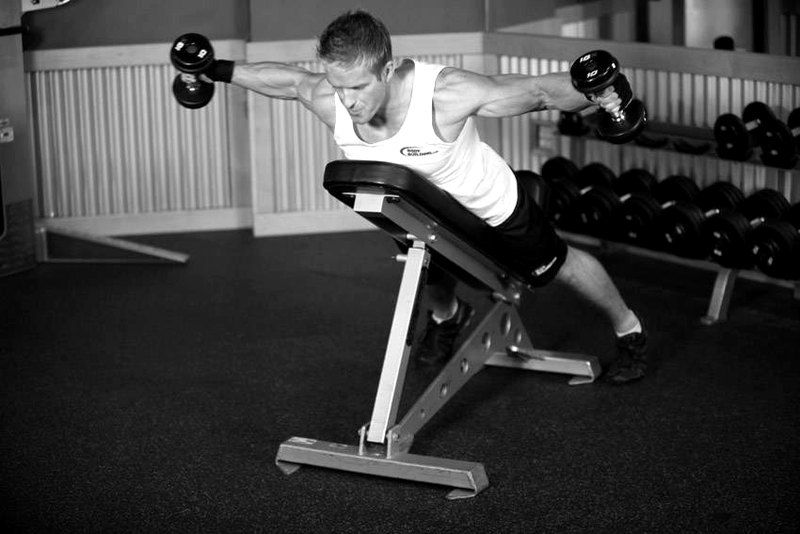
Start and end of one clean rep of Reverse Flyes With External Rotation.
Quick facts
| Primary muscle | Shoulders |
|---|---|
| Secondary muscles | — |
| Equipment | Dumbbell |
| Category | Strength |
How to perform Reverse Flyes With External Rotation
- To begin, lie down on an incline bench set at a 30-degree angle with the chest and stomach pressing against the incline.
- Have the dumbbells in each hand with the palms facing down to the floor. Your arms should be in front of you so that they are perpendicular to the angle of the bench. Tip: Your elbows should have a slight bend. The legs should be stationary while applying pressure with the ball of your toes (your heels should not be touching the floor). This is the starting position.
- Maintaining the slight bend of the elbows, move the weights out and away from each other in an arc motion while exhaling.
- As you lift the weight, your wrist should externally rotate by 90-degrees so that you go from a palms down (pronated) grip to a palms facing each other (neutral) grip. Tip: Try to squeeze your shoulder blades together to get the best results from this exercise.
- The arms should be elevated until they are level with the head.
- Feel the contraction and slowly lower the weights back down to the starting position while inhaling.
- Repeat for the recommended amount of repetitions.
Muscles worked
- Shoulders (primary): raises and rotates the arms and drives everything overhead.
Sets & reps by goal
| Goal | Sets × reps | Load | Rest |
|---|---|---|---|
| Strength | 3–5 × 3–5 | Heavy (~85%+) | 2–3 min |
| Hypertrophy | 3–4 × 8–12 | Moderate (~65–75%) | 60–90 s |
| Endurance | 2–3 × 15–20 | Lighter (~50–60%) | 30–45 s |
Pick the row that matches your goal. If you're newer, anchor in the hypertrophy range while you groove the form.
Form tips
- Keep the ribs down and the glutes tight so the lower back doesn't arch to 'help' the weight up.
- Each side works on its own, so match the depth and speed of both arms and don't let the stronger side take over.
- Treat every rep the same — a repeatable setup and bar path is what lets you add weight safely over time.
- Stop a rep or two short of failure on most sets to keep form clean and recover faster.
Common mistakes
- Pressing with the lower back arched instead of a braced, stacked torso.
- Letting the dumbbells drift apart or clang together at the top instead of controlling the path.
- Chasing weight jumps before the current load feels solid on every rep.
Frequently asked questions
What muscles does Reverse Flyes With External Rotation work?
Reverse Flyes With External Rotation is a focused movement that primarily works the shoulders.
What equipment do I need for Reverse Flyes With External Rotation?
Reverse Flyes With External Rotation needs a pair of dumbbells.
How many sets and reps should I do for Reverse Flyes With External Rotation?
It depends on your goal: about 3–5 sets of 3–5 heavy reps for strength, 3–4 sets of 8–12 for muscle growth, or 2–3 sets of 15–20 for endurance. Pick the row that matches your goal. If you're newer, anchor in the hypertrophy range while you groove the form.
Train Reverse Flyes With External Rotation with a coach in your pocket
Gimmy is your AI gym buddy — it programs Reverse Flyes With External Rotation into recovery-aware workouts, tracks your sets, and shows one score that tells you if it's working.
Get early access