How to Do Log Lift
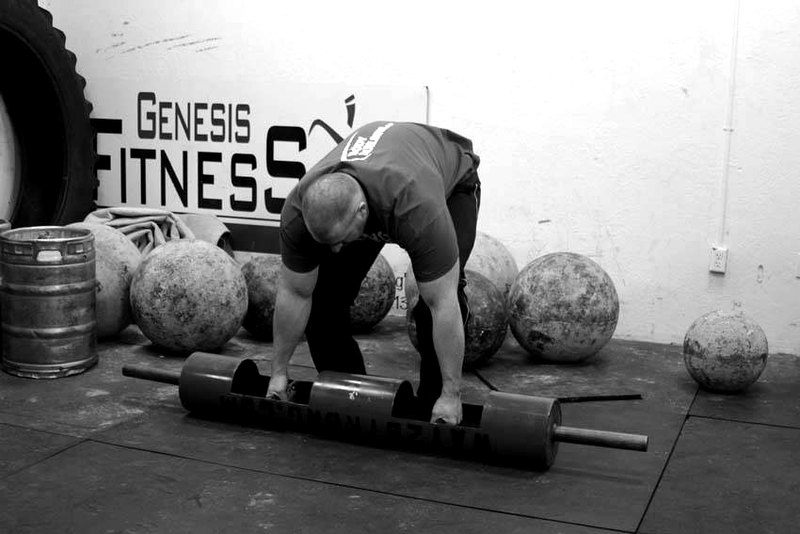
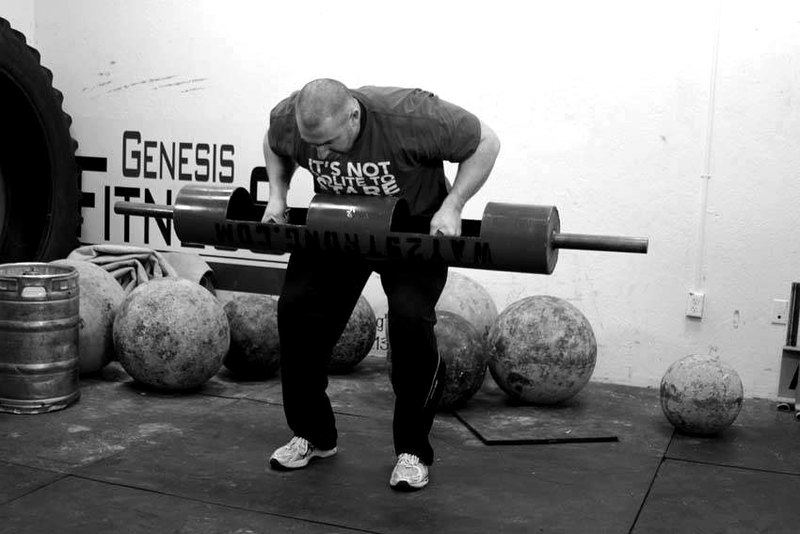
Start and end of one clean rep of Log Lift.
Quick facts
| Primary muscle | Shoulders |
|---|---|
| Secondary muscles | Core, Chest, Glutes, Hamstrings, Back, Quads, Triceps |
| Equipment | Machine |
| Category | Strongman |
How to perform Log Lift
- Begin standing with the log in front of you. Grasp the handles, and begin to clean the log. As you are bent over to start the clean, attempt to get the log as high as possible, pulling it into your chest. Extend through the hips and knees to bring it up to complete the clean.
- Push your head back and look up, creating a shelf on your chest to rest the log. Begin the press by dipping, flexing slightly through the knees and reversing the motion. This push press will generate momentum to start the log moving vertically. Continue by extending through the elbows to press the log above your head. There are no strict rules on form, so use whatever techniques you are most efficient with. As the log is pressed, ensure that you push your head through on each repetition, looking forward.
- Repeat as many times as possible. Attempt to control the descent of the log as it is returned to the ground.
Muscles worked
- Shoulders (primary): raises and rotates the arms and drives everything overhead.
- Core (secondary): braces the trunk and resists twisting to protect the spine.
- Chest (secondary): pushes the arms forward and across the body — your horizontal pressing power.
- Glutes (secondary): extends and stabilises the hip — the engine behind hinges, squats and sprints.
- Hamstrings (secondary): bends the knee and extends the hip through hinges and pulls.
- Back (secondary): pulls the arms down and toward the torso and keeps the spine stable.
- Quads (secondary): extends the knee to drive squats, lunges and jumps.
- Triceps (secondary): straightens the elbow to lock out every press and pushdown.
Sets & reps by goal
| Goal | Sets × reps | Load | Rest |
|---|---|---|---|
| Strength | 3–5 × 3–5 | Heavy (~85%+) | 2–3 min |
| Hypertrophy | 3–4 × 8–12 | Moderate (~65–75%) | 60–90 s |
| Endurance | 2–3 × 15–20 | Lighter (~50–60%) | 30–45 s |
Pick the row that matches your goal. If you're newer, anchor in the hypertrophy range while you groove the form.
Form tips
- Keep the ribs down and the glutes tight so the lower back doesn't arch to 'help' the weight up.
- Set the seat and pads so the machine's pivot lines up with the joint you're training before your first rep.
- Brace hard and keep a neutral spine; loaded odd-object work punishes a loose torso fast.
- Warm up the pattern with a couple of lighter, submaximal sets before your working sets.
Common mistakes
- Pressing with the lower back arched instead of a braced, stacked torso.
- Leaving the seat or range on a setting that forces the joint into an awkward angle.
- Letting the torso round the moment the object leaves the floor.
Frequently asked questions
What muscles does Log Lift work?
Log Lift mainly works the shoulders, with the core, chest, glutes, hamstrings, back, quads, triceps helping as secondary movers.
What equipment do I need for Log Lift?
Log Lift needs the corresponding weight-stack or plate-loaded machine.
How many sets and reps should I do for Log Lift?
It depends on your goal: about 3–5 sets of 3–5 heavy reps for strength, 3–4 sets of 8–12 for muscle growth, or 2–3 sets of 15–20 for endurance. Pick the row that matches your goal. If you're newer, anchor in the hypertrophy range while you groove the form.
Train Log Lift with a coach in your pocket
Gimmy is your AI gym buddy — it programs Log Lift into recovery-aware workouts, tracks your sets, and shows one score that tells you if it's working.
Get early access