How to Do Hyperextensions (Back Extensions)
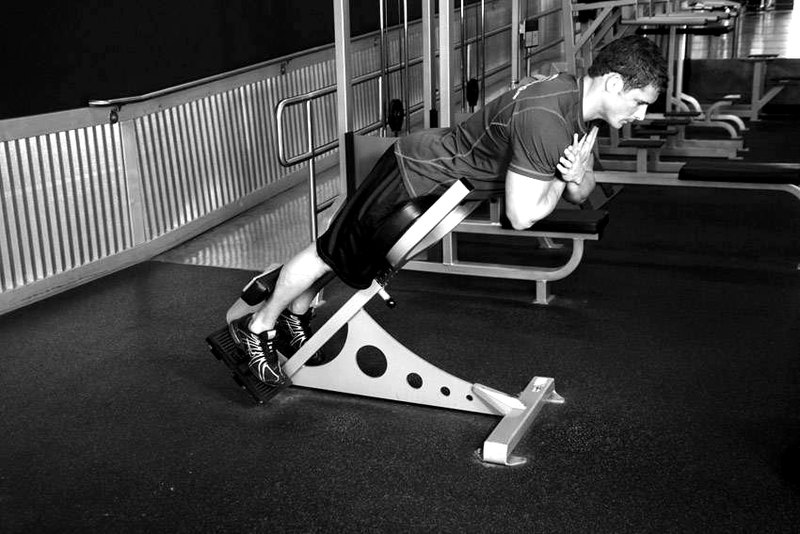
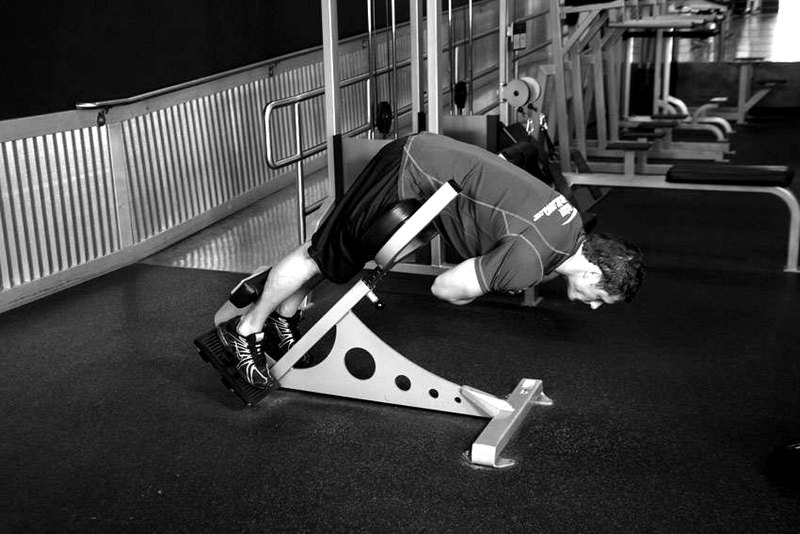
Start and end of one clean rep of Hyperextensions (Back Extensions).
Quick facts
| Primary muscle | Hamstrings |
|---|---|
| Secondary muscles | Glutes, Core |
| Equipment | Machine |
| Category | Strength |
How to perform Hyperextensions (Back Extensions)
- Lie face down on a hyperextension bench, tucking your ankles securely under the footpads.
- Adjust the upper pad if possible so your upper thighs lie flat across the wide pad, leaving enough room for you to bend at the waist without any restriction.
- With your body straight, cross your arms in front of you (my preference) or behind your head. This will be your starting position. Tip: You can also hold a weight plate for extra resistance in front of you under your crossed arms.
- Start bending forward slowly at the waist as far as you can while keeping your back flat. Inhale as you perform this movement. Keep moving forward until you feel a nice stretch on the hamstrings and you can no longer keep going without a rounding of the back. Tip: Never round the back as you perform this exercise. Also, some people can go farther than others. The key thing is that you go as far as your body allows you to without rounding the back.
- Slowly raise your torso back to the initial position as you inhale. Tip: Avoid the temptation to arch your back past a straight line. Also, do not swing the torso at any time in order to protect the back from injury.
- Repeat for the recommended amount of repetitions.
Muscles worked
- Hamstrings (primary): bends the knee and extends the hip through hinges and pulls.
- Glutes (secondary): extends and stabilises the hip — the engine behind hinges, squats and sprints.
- Core (secondary): braces the trunk and resists twisting to protect the spine.
Sets & reps by goal
| Goal | Sets × reps | Load | Rest |
|---|---|---|---|
| Strength | 3–5 × 3–5 | Heavy (~85%+) | 2–3 min |
| Hypertrophy | 3–4 × 8–12 | Moderate (~65–75%) | 60–90 s |
| Endurance | 2–3 × 15–20 | Lighter (~50–60%) | 30–45 s |
Pick the row that matches your goal. If you're newer, anchor in the hypertrophy range while you groove the form.
Form tips
- Lead with the hips, keep a soft knee and hold a long, flat back through the hinge.
- Set the seat and pads so the machine's pivot lines up with the joint you're training before your first rep.
- Treat every rep the same — a repeatable setup and bar path is what lets you add weight safely over time.
- Stop a rep or two short of failure on most sets to keep form clean and recover faster.
Common mistakes
- Rounding the lower back to reach lower instead of hinging at the hips.
- Leaving the seat or range on a setting that forces the joint into an awkward angle.
- Chasing weight jumps before the current load feels solid on every rep.
Frequently asked questions
What muscles does Hyperextensions (Back Extensions) work?
Hyperextensions (Back Extensions) mainly works the hamstrings, with the glutes, core helping as secondary movers.
What equipment do I need for Hyperextensions (Back Extensions)?
Hyperextensions (Back Extensions) needs the corresponding weight-stack or plate-loaded machine.
How many sets and reps should I do for Hyperextensions (Back Extensions)?
It depends on your goal: about 3–5 sets of 3–5 heavy reps for strength, 3–4 sets of 8–12 for muscle growth, or 2–3 sets of 15–20 for endurance. Pick the row that matches your goal. If you're newer, anchor in the hypertrophy range while you groove the form.
Train Hyperextensions (Back Extensions) with a coach in your pocket
Gimmy is your AI gym buddy — it programs Hyperextensions (Back Extensions) into recovery-aware workouts, tracks your sets, and shows one score that tells you if it's working.
Get early access