How to Do Freehand Jump Squat
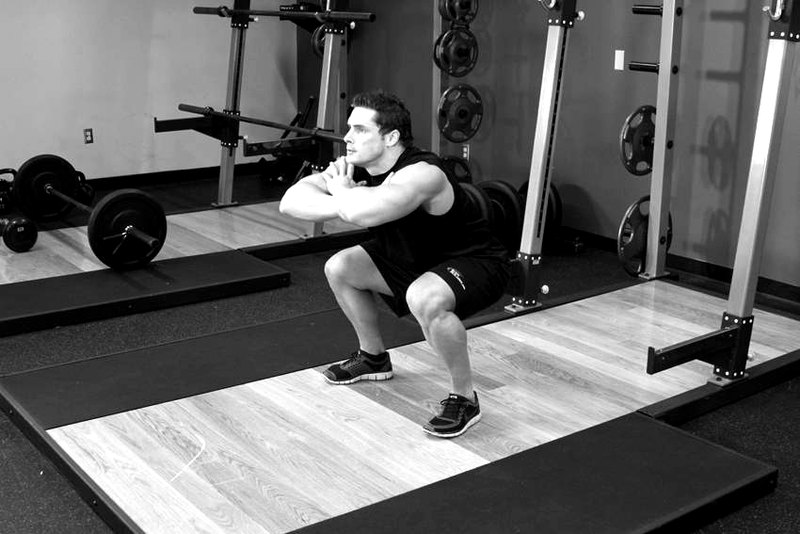
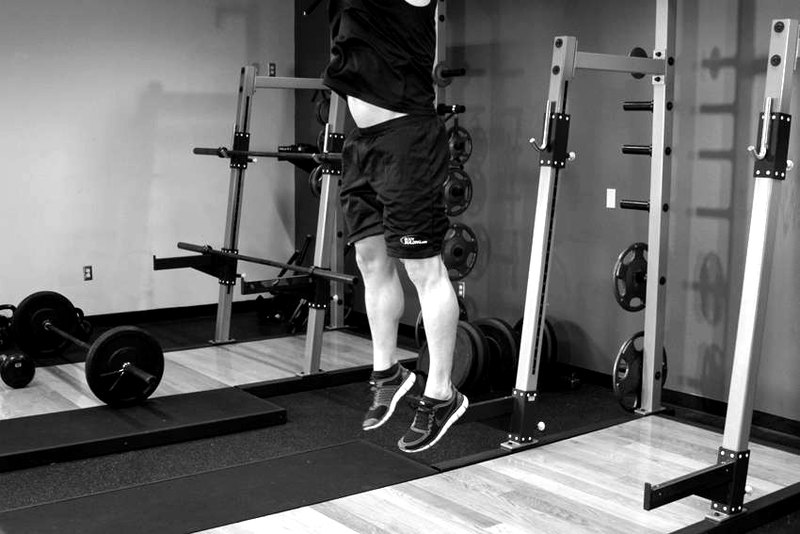
Start and end of one clean rep of Freehand Jump Squat.
Quick facts
| Primary muscle | Quads |
|---|---|
| Secondary muscles | Calves, Glutes, Hamstrings |
| Equipment | Bodyweight |
| Category | Strength |
How to perform Freehand Jump Squat
- Cross your arms over your chest.
- With your head up and your back straight, position your feet at shoulder width.
- Keeping your back straight and chest up, squat down as you inhale until your upper thighs are parallel, or lower, to the floor.
- Now pressing mainly with the ball of your feet, jump straight up in the air as high as possible, using the thighs like springs. Exhale during this portion of the movement.
- When you touch the floor again, immediately squat down and jump again.
- Repeat for the recommended amount of repetitions.
Muscles worked
- Quads (primary): extends the knee to drive squats, lunges and jumps.
- Calves (secondary): points the foot to power push-off and steady the ankle.
- Glutes (secondary): extends and stabilises the hip — the engine behind hinges, squats and sprints.
- Hamstrings (secondary): bends the knee and extends the hip through hinges and pulls.
Sets & reps by goal
| Goal | Sets × reps | Load | Rest |
|---|---|---|---|
| Strength | 3–5 × 3–5 | Heavy (~85%+) | 2–3 min |
| Hypertrophy | 3–4 × 8–12 | Moderate (~65–75%) | 60–90 s |
| Endurance | 2–3 × 15–20 | Lighter (~50–60%) | 30–45 s |
Bodyweight movement: once you own the top of a rep range, progress by slowing the tempo, pausing at the hardest point, or moving to a harder variation instead of adding load.
Form tips
- Keep the knees tracking in line with the toes and push the whole foot into the floor.
- Own the largest range you can control with clean form before you chase extra reps.
- Treat every rep the same — a repeatable setup and bar path is what lets you add weight safely over time.
- Control the lowering phase — a 2–3 second descent builds more than dropping the weight.
Common mistakes
- Letting the knees cave inward as you push out of the bottom.
- Cutting the range short to squeeze out extra reps instead of owning each full one.
- Chasing weight jumps before the current load feels solid on every rep.
Frequently asked questions
What muscles does Freehand Jump Squat work?
Freehand Jump Squat mainly works the quads, with the calves, glutes, hamstrings helping as secondary movers.
What equipment do I need for Freehand Jump Squat?
None — Freehand Jump Squat is a bodyweight movement, so you only need your bodyweight and a little space.
How many sets and reps should I do for Freehand Jump Squat?
It depends on your goal: about 3–5 sets of 3–5 heavy reps for strength, 3–4 sets of 8–12 for muscle growth, or 2–3 sets of 15–20 for endurance. Bodyweight movement: once you own the top of a rep range, progress by slowing the tempo, pausing at the hardest point, or moving to a harder variation instead of adding load.
Train Freehand Jump Squat with a coach in your pocket
Gimmy is your AI gym buddy — it programs Freehand Jump Squat into recovery-aware workouts, tracks your sets, and shows one score that tells you if it's working.
Get early access